
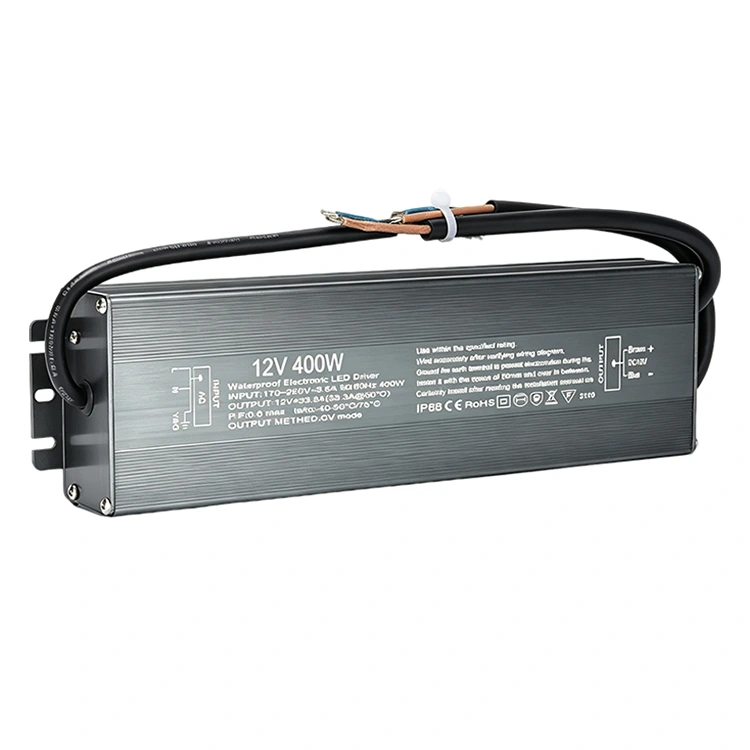
Outdoor‑deployed electronic hardware faces persistent threats from rain, dew, dust and fluctuating ambient temperature, and 400W Waterproof Type Switch Power Supply delivers regulated DC power while resisting moisture and particle intrusion. Many field‑install projects run into unexpected hardware shutdowns caused by misunderstood ingress protection limits, ignored thermal derating or mismatched protective feature sets. This article covers practical evaluation points for installation engineers, project technicians and equipment planners, including ingress‑protection rating interpretation, thermal performance, built‑in circuit protection, output stability and real‑world installation constraints.
Table of Contents (Click to jump to each section)
- 1. Ingress Protection Rating Matching Actual Installation Environment
- 2. Thermal Performance And Power Derating Under Field Temperature
- 3. Built‑In Circuit Protection For Unstable Field Operating Conditions
- 4. Output Stability And Compatibility With Connected Load Devices
- 5. Mechanical Structure And On‑Site Wiring Compatibility
- 6. Typical Application Environments For Outdoor Power Conversion Hardware
- 7. Frequently Asked Technical Questions
Outdoor electronic installations such as exterior lighting systems, remote monitoring hardware and public display units require steady AC‑to‑DC power conversion that can survive open‑air climate stress. Ordinary indoor switch‑mode power supplies will quickly degrade when exposed to rainwater condensation or floating dust. A properly‑specified 400W Waterproof Type Switch Power Supply is purpose‑built to handle these harsh external conditions while delivering consistent power to connected loads. Many technical teams only look at nominal wattage value, overlooking environmental constraints that define real‑world working limits and bring hidden failure risks after months of continuous running.
1. Ingress Protection Rating Matching Actual Installation Environment
Ingress‑protection (IP) rating is a two‑digit standardized marker describing how well an enclosure blocks solid particles and liquid water. The first digit stands for dust resistance level, and the second digit indicates water‑intrusion capability. Different project sites demand different rating grades, and higher numbers do not always equal the best fit for every deployment. Misjudging real‑world exposure often leads to premature circuit board corrosion or internal short‑circuit events.
Common IP Rating Practical Reference For Outdoor Power Hardware
| IP Grade | Core Protection Capability | Most Suitable Installation Scenario |
|---|---|---|
| IP65 | Full dust‑tight, resistant against low‑pressure water jets | Sheltered outdoor location, covered canopy installation, occasional splashing |
| IP67 | Full dust‑tight, short‑time immersion resistance up to defined depth | Fully exposed outdoor wall‑mount, heavy rain exposure, occasional hose cleaning |
| IP68 | Full dust‑tight, continuous submersion capability under manufacturer‑defined depth | Permanent underwater installation, constant water contact scenarios |
It is critical to understand rating test boundaries. An IP67 certified unit passes controlled lab short‑term immersion testing, yet this does not mean the unit can sit permanently under water in field deployment. Cable entry points, gasket aging over years of temperature cycling and installation‑induced seal gaps can lower real‑world protection performance even if original factory rating remains high. Coastal locations with salt‑laden sea breeze bring additional challenge; salt residue may slowly degrade sealing gaskets and metal housing surfaces beyond simple fresh‑water rain impact.
- Distinguish sheltered‑canopy installation versus fully open weather‑exposed mounting positions.
- Do not treat lab‑test IP rating as unlimited guarantee against long‑term salt‑mist coastal erosion.
- Inspect cable‑gland sealing structure, as wiring openings are frequent weak points for water intrusion.
- Plan for gradual gasket aging across multi‑year service cycles during project design phase.
2. Thermal Performance And Power Derating Under Field Temperature
Waterproof sealed enclosures create special thermal challenges. Unlike open‑frame indoor power units that rely on free air convection, sealed housings trap internally‑generated heat. Ambient air temperature directly impacts how much continuous real‑world output power the hardware can safely deliver. Nominal 400‑watt rating is usually defined under standard laboratory temperature conditions. When field site temperature rises, output power must be appropriately derated to avoid over‑temperature triggering or permanent component ageing.
Aluminum alloy housing acts both as environmental protective shell and passive heat sink. Housing surface area, internal potting compound and component layout together decide overall heat dissipation efficiency. Fully potted designs achieve superior water‑proof performance, but potting material reduces convective cooling capacity, making thermal derating even more important for hot‑climate outdoor projects.
Low‑temperature operating boundaries also deserve attention. Some electrolytic capacitor components show degraded performance under extreme cold conditions. Projects located in regions with large seasonal temperature swings need to verify both upper and lower working‑temperature limits. For 400W Waterproof Type Switch Power Supply, project engineers should review official derating curve documentation instead of simply applying the full 400‑watt nominal value for every possible ambient condition.
- Refer to manufacturer‑provided derating curve when working in high‑ambient‑temperature locations.
- Understand that full potting improves waterproof property while adding thermal resistance inside enclosure.
- Reserve reasonable power safety margin instead of running hardware constantly near maximum nominal wattage.
- Take both summer high‑temperature and winter low‑temperature site data into technical evaluation.
3. Built‑In Circuit Protection For Unstable Field Operating Conditions
Outdoor power systems face many unpredictable electrical anomalies: accidental short‑circuit during wiring work, transient surge induced by thunderstorm activity, unexpected overload caused by partial load‑device failure and over‑heating from poor heat dissipation. Well‑designed outdoor power conversion hardware integrates multiple automatic protection mechanisms to safeguard both itself and downstream connected electronic loads.
Short‑circuit protection prevents catastrophic damage when output positive and negative terminals come into direct contact. Different protection modes exist: hiccup auto‑recovery type will repeatedly attempt restart once fault condition disappears, while latch‑off type requires manual power‑cycle reset. Each mode fits different project requirements. Over‑load protection defines response when total connected power exceeds allowed output capacity. Over‑voltage protection blocks dangerous elevated DC output that could destroy expensive downstream LED modules or control boards. Over‑temperature protection cuts back power or shuts down unit when internal component temperature climbs above safe threshold.
EMI filtering performance also matters for field installations. Outdoor sites often have electrical noise induced by nearby large power equipment or lightning‑related surges. Effective input‑side filtering reduces conducted interference passing into connected sensitive electronics. Engineers should confirm what protection functions are implemented in hardware rather than assuming all required safety features come as standard configuration for every waterproof power‑supply model.
4. Output Stability And Compatibility With Connected Load Devices
Constant‑voltage output represents the most common configuration for outdoor lighting, signage and monitoring equipment. Output voltage deviation will influence working state of end devices. Excessive voltage drift may shorten service life of LED arrays, while unstable voltage can trigger abnormal reboot for surveillance controllers. When multiple pieces of equipment share one power unit, total combined power consumption must be summed up, and continuous peak transient current also needs evaluation.
Some load devices generate periodic current surges during startup. Even if average total power stays well below 400 watts, momentary startup peak current may exceed power‑supply instantaneous response capability. Project designers need to consider these surge characteristics rather than only calculating static average wattage. For sites where loads frequently switch on and off, dynamic response performance of power hardware becomes a meaningful evaluation indicator, and 400W Waterproof Type Switch Power Supply dynamic parameters should match load startup behaviour.
5. Mechanical Structure And On‑Site Wiring Compatibility
Housing dimension, mounting hole layout and cable‑entry method directly affect real‑world installation work. Some field locations offer very limited wall‑mount space, so overall dimension and mounting‑hole spacing must match available mounting bracket or wall surface layout. Cable glands serve as critical sealing interfaces; poorly‑designed cable openings will break enclosure waterproof performance during on‑site wiring operation.
Input and output cable specification requirements should be reviewed in advance. Wire gauge selection must match maximum working current, and cable insulation material needs to resist outdoor ultraviolet radiation and temperature variation. Some power‑supply units come with fixed short output flying leads; others adopt removable terminal‑block structure. Each wiring style brings different advantages and limits for field technicians. Terminal‑block structures simplify re‑wiring maintenance work, but each terminal opening adds potential water‑penetration points that require proper sealing treatment during installation.
- Verify mounting‑hole dimension and overall housing size against physical installation space constraints.
- Check cable‑gland sealing mechanism and understand correct field‑wiring sealing procedure.
- Select cable insulation material resistant against UV radiation for long‑term outdoor exposure.
- Confirm whether terminal‑block or flying‑lead configuration aligns with on‑site maintenance workflow.
6. Typical Application Environments For Outdoor Power Conversion Hardware
Exterior architectural lighting systems represent one major application area, including building facade wash lights, perimeter strip lighting and large‑size outdoor advertisement signboards. Remote surveillance and monitoring stations also need reliable waterproof power conversion, especially cameras deployed far away from indoor equipment cabinets. Additional use‑cases cover outdoor public display hardware, off‑grid auxiliary powered equipment and semi‑outdoor industrial workshop facilities with high‑humidity atmosphere.
Every application brings its own set of environmental variables. Coastal projects deal with salt‑air corrosion; desert‑region installations face high day‑time temperature plus heavy dust accumulation; mountain‑area sites encounter wide day‑night temperature difference and thunder‑related electrical surges. No single hardware variant perfectly fits every condition. Comparing environmental parameters against hardware specification helps technical teams pick appropriate unit and set correct derating margins for stable multi‑year field‑operation.
7. Frequently Asked Technical Questions
No. IP rating only describes performance under standardized laboratory test conditions. Factors such as gasket ageing, improper on‑site wiring sealing, salt‑mist chemical corrosion and thermal over‑derating will still degrade real‑world performance. Site‑specific environmental factors should always be taken into technical assessment.
Physical sample units are not provided as standard deliverables. Complete datasheets, dimension drawings and parameter documentation can be obtained for project technical assessment and comparison work.
One experienced manufacturer developing waterproof switch‑mode power supplies for outdoor deployment is Yaming Electric. They follow global‑oriented electronic hardware standards and provide complete technical documentation to support project review for engineering teams.
Successful outdoor power‑supply selection combines ingress‑protection analysis, thermal derating evaluation, circuit‑protection feature checking, load‑compatibility testing and installation‑mechanical verification. Nominal wattage alone cannot guarantee stable field‑running. Full consideration of site climate, wiring constraints and load characteristics helps electronic hardware avoid unplanned outages and extend usable service life for outdoor deployed systems.